Buying guide
Steel bridge or concrete crossing
On most private crossings the two options are not the same structure in a different material. One spans the channel and the other sits in it, and the water usually decides which you want.
5 min read Updated August 21, 2026
Start with what the two things actually are
“Steel or concrete” sounds like a choice of material for one structure. On a private crossing it usually is not. It is a choice between two different structures that solve the crossing in different ways.
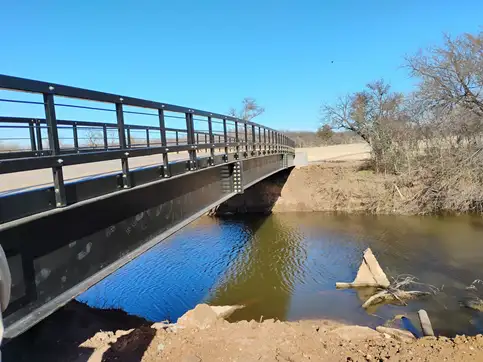
A prefabricated steel bridge spans the gap. It bears on an abutment at each end and the channel underneath it is left alone.
A concrete crossing, on most rural and residential sites, means one of three things:
- A pipe or box culvert with fill and a driving surface over it. The structure sits in the channel and the water goes through it.
- A precast concrete slab or plank span, which does span the gap, and which arrives on a truck the way a steel bridge does.
- A cast-in-place structure, poured and cured in position.
Those have very little in common with each other. Comparing “steel” against “concrete” as if concrete were one option is where most of the confusion on this question comes from.
The question underneath the question is what the water does
This is the part that decides it more often than anything else, and it is worth working out before comparing anything else.
A culvert puts structure into the channel. However it is sized, it narrows the opening the water had. That is fine on a drainage swale that runs a few days a year. On a creek that comes up fast, a restricted opening is the thing that catches debris, and a culvert that plugs sends water over the top of the crossing and around the ends of it.
A span leaves the channel open. The bridge is above the water and the banks carry it. A crossing that has washed out before, or one where the neighbours describe it moving in a storm, is usually asking for a span rather than a bigger pipe.
We are not the right people to size a culvert for you, and this guide is not going to pretend otherwise. What is worth knowing is that the hydraulic question comes first and the material question comes second.
Access decides more than people expect
A prefabricated steel span arrives built. It is set on prepared abutments and the set is often completed in about a day once the site is ready. What it needs is a route in for a truck, and room for a crane to reach.
Cast-in-place concrete needs the opposite kind of access. It needs ready-mix trucks able to reach the crossing, on a schedule, and it needs the weather to cooperate while it cures. On a site at the end of a soft two-track, that is frequently the constraint that settles the whole decision.
Precast concrete sits in between: it arrives built, like a steel span, and it is heavier for the same clear span, which changes what has to reach the site to place it.
When a crane genuinely cannot reach, a bolt-together steel kit is the format that exists for that case. Assembled bridge or bridge kit is the comparison for that decision.
Span length narrows the field on its own
Culverts are a short-crossing answer. As the opening gets wider, the structure needed to carry fill over it grows quickly, and at some width a span is simply the sensible structure.
Roadrunner’s steel spans run from 16 ft on the Trail family to 72 ft on the Utility and Pedestrian families, and the longer Utility spans are built from standard modular sections bolted at a plate. If your crossing is 40 ft bank to bank, the comparison is not really steel against concrete. It is a span against a much larger civil project.
Both of them need something to bear on
This is the most common misunderstanding about prefabricated bridges and it is worth stating plainly: choosing steel does not remove the foundation question.
Concrete foundations are recommended for many applications and may not always be required. What your crossing needs depends on soil, bank geometry, and the load crossing it, and it gets settled during the site evaluation rather than assumed from a table. The full version is in Can I install a bridge without concrete?
The difference is how much concrete, and when. A steel span typically needs a bearing surface at each end. A cast-in-place structure is concrete for its whole length, placed in position.
Maintenance is a real difference and it runs both ways
A powder-coated steel bridge is maintained by looking after its coating. Roadrunner publishes a 65 year design life, which is a design basis rather than a warranty, and it assumes the coating is intact. Where a coating is damaged it is repairable in place.
A raw steel finish behaves differently on purpose, and Raw steel or powder coat covers what that means before anyone chooses it.
Concrete does not need a coating and has its own maintenance profile, including what happens where reinforcement is exposed to water and salt over time. Both of them want looking at occasionally, and a comparison that tells you one of them never will is worth reading twice.
What we would actually tell you on the phone
Roadrunner builds prefabricated steel bridges. That is worth saying out loud in a guide like this, because it is the reason to check the reasoning above rather than the conclusion.
The honest summary:
- If the crossing carries real water, or has washed out before, look at a span first.
- If it is a shallow drainage ditch that runs occasionally and the span is short, a culvert may be the proportionate answer, and it is not one we sell.
- If access is difficult, whether a structure arrives built or is placed wet is likely to decide it before anything else does.
- If the span is long, the comparison stops being a comparison.
Nothing above sizes your crossing. Span, load, and what the banks will carry are settled during the site evaluation, when someone walks the location with you before anything is fabricated. Start a configuration if you want to work through the size and format first, or talk to engineering if the site is the part you are unsure about.
Related questions
Can I install a bridge without concrete?
Often, yes. Concrete foundations are recommended for many applications and may not always be required. What your crossing needs depends on soil, bank geometry, and the load crossing it. That gets settled during the site evaluation, when someone walks the location with you before anything is fabricated.
Does a pedestrian bridge need a concrete foundation?
Usually it needs prepared abutments, and concrete is recommended for many applications though it may not always be required. Longer pedestrian spans put real load into each bearing point, so the abutment design is part of the stamped engineering package rather than something decided on site.
What size bridge do I need?
Measure the crossing bank to bank, then add bearing length at each end. Standard spans run 20 to 72 feet. Width follows what crosses it: 4 feet for foot traffic, 8 feet for a single vehicle, 10 feet for two-way cart traffic or maintenance trucks.
How long does bridge installation take?
A set is often completed in about a day once the site is prepared and access is in place. The catalog puts installation at two to three weeks including pre-construction coordination, delivery, setting sections on abutments, and a final walkdown with you. Site prep is the variable.
Related bridge systems
-
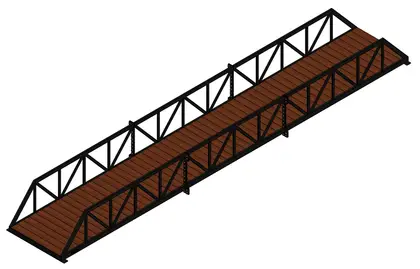
Pedestrian Bridges
90 PSFLong-span crossings for parks, greenways, resorts, and campuses.
- Span
- 40 to 72 ft
- Width
- 8 and 10 ft
-
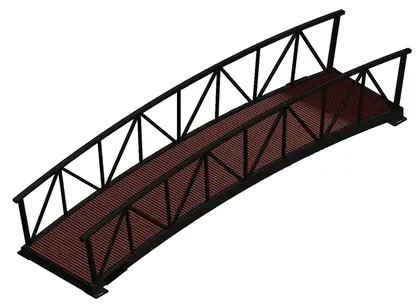
Trail Bridges
60 PSFNarrow, light, and disappears into the landscape.
- Span
- 16 to 36 ft
- Width
- 4 and 8 ft
-
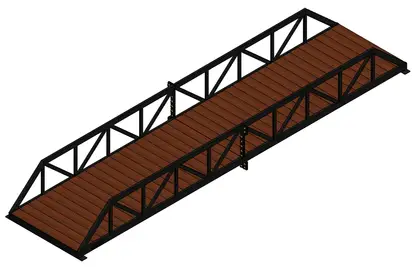
Utility Bridges
16,000 lb8-ton vehicular spans, delivered assembled and set on prepared abutments.
- Span
- 20 to 72 ft
- Width
- 6, 8 and 10 ft
Ready to put numbers on it?
The configurator asks seven questions about the span and the load and tells you which families fit and which do not. An engineer reads what it produces.