Engineering
What bridge load ratings mean
Roadrunner publishes two kinds of rating and they are not comparable. This is what each one describes, what the configurator sizes your answer against, and why a photograph of a machine on a bridge is not permission.
3 min read Updated August 6, 2026
Two units, measuring different things
A rating in tons and a rating in pounds per square foot are not two ways of saying the same number, and they cannot be converted into each other.
| Family | Rating | What it describes |
|---|---|---|
| Trail | 60 PSF | Uniform distributed load, for people on a 4 ft path |
| Pedestrian | 90 PSF | Uniform distributed load, for a public walkway |
| Kit | 4 ton, 2 tons per axle | A vehicle, in the cataloged 20 ft configuration |
| Utility | 8 ton, 16,000 lb | A vehicle, across spans of 20 to 72 ft |
A distributed rating answers “how many people can stand on this”. A vehicle rating answers “how heavy a machine can drive over it”. A crossing that carries a crowd is not thereby rated for a tractor, and the Trail’s 60 PSF is not a smaller version of the Kit’s 4 ton.
What the rating is attached to
Every published figure is stated for the configuration it was engineered in: a span, a width, a deck, and a rail. The Trail’s 60 PSF is stated on FRP composite decking. Change the deck and the rating is no longer the published one.
This is why the specification sheets name the configuration beside the number, and why nothing on this site quotes a capacity without one.
What a vehicle answer is sized against
The configurator asks what crosses and sizes the answer against the heavy end of that class, because “skid steer” names a class of machine rather than a machine.
| Answer | Sized against |
|---|---|
| Light utility vehicles | 2,000 to 4,000 lb |
| Golf cart or UTV | 1,500 to 4,000 lb |
| Pickup truck | 4,000 to 8,000 lb |
| Tractor | 6,000 to 12,000 lb |
| Skid steer | 8,000 to 16,000 lb |
| Telehandler | 8,000 to 24,000 lb |
A compact utility tractor and a row crop tractor are both tractors and are 15,000 lb apart. If the recommendation is being made off the class rather than the machine, it has to assume the heavy one. Tell an engineer the actual model and the check is done against that instead.
Telehandlers top the table at 24,000 lb, which is above every published family. That is not a gap in the catalog, it is the honest answer: those crossings are engineered against the actual loading.
What weight does not capture
Two machines of the same weight do not load a deck the same way if one carries it through two axles and the other through four. Axle spacing is not something the configurator asks about, so every check it makes is weight against weight, which is how the published ratings are themselves stated.
That is enough to rule a family out. It is not enough to rule one in for a particular site.
Rated is not the same as survived
Roadrunner load tests, and a bridge will carry more than its rating before anything dramatic happens. That is exactly why the rating is the number to buy against.
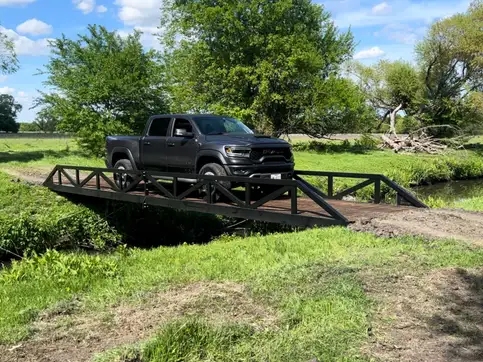
A machine heavier than the rating can cross and leave permanent deflection: the bridge does not fail, it is simply never straight again. So a photograph of a heavy machine on a bridge shows what happened once, not what is recommended, and it establishes nothing at all about a different model in a different configuration.
Published ratings apply to the cataloged configuration. What your crossing will carry depends on the engineered configuration for your site, which is settled during design. Nothing on this page is an engineering approval.
Related questions
How much weight can a steel bridge hold?
It depends on the family and the configuration. Utility Truss models are rated 8 ton, or 16,000 pounds. Bolt-together kits are rated 4 ton. Pedestrian models are rated 90 PSF as a distributed load. Final capacity for your site comes from the engineered configuration, not a catalog number.
Can I drive a tractor across one of these bridges?
Utility Truss models are the vehicular family, rated 8 ton, or 16,000 pounds, across spans from 20 to 72 feet. Whether that covers your tractor depends on its loaded weight and axle spacing. Send us the machine and the crossing dimensions and we will confirm against the engineered configuration.
What size bridge do I need?
Measure the crossing bank to bank, then add bearing length at each end. Standard spans run 20 to 72 feet. Width follows what crosses it: 4 feet for foot traffic, 8 feet for a single vehicle, 10 feet for two-way cart traffic or maintenance trucks.
Related bridge systems
-
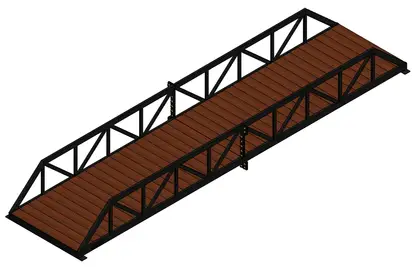
Utility Bridges
16,000 lb8-ton vehicular spans, delivered assembled and set on prepared abutments.
- Span
- 20 to 72 ft
- Width
- 6, 8 and 10 ft
-
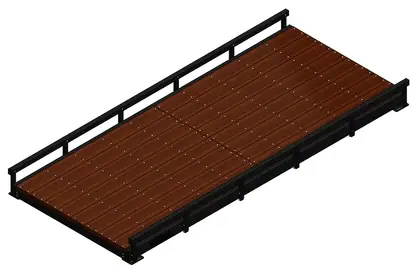
Bridge Kits
8,000 lbShips flat. Bolts together on site. No crane.
- Span
- 20 to 30 ft
- Width
- 8 and 10 ft
-
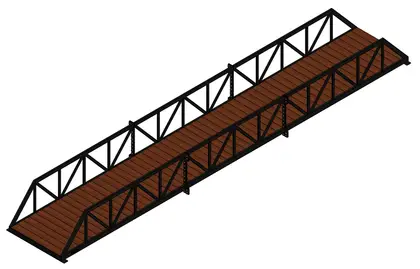
Pedestrian Bridges
90 PSFLong-span crossings for parks, greenways, resorts, and campuses.
- Span
- 40 to 72 ft
- Width
- 8 and 10 ft
Ready to put numbers on it?
The configurator asks seven questions about the span and the load and tells you which families fit and which do not. An engineer reads what it produces.