Installation
Assembled bridge or bridge kit
This is not really a preference. Site access and span decide it, and on most crossings only one of the two is available.
2 min read Updated August 6, 2026
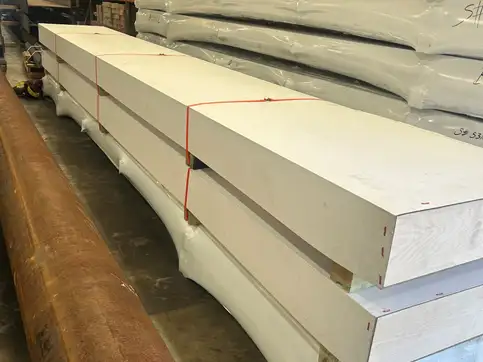
The two formats
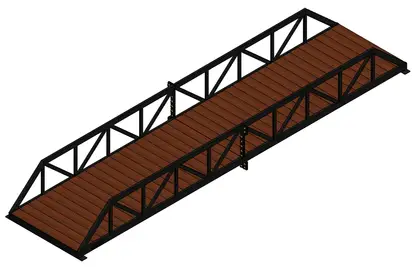
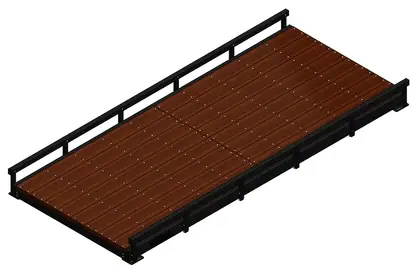
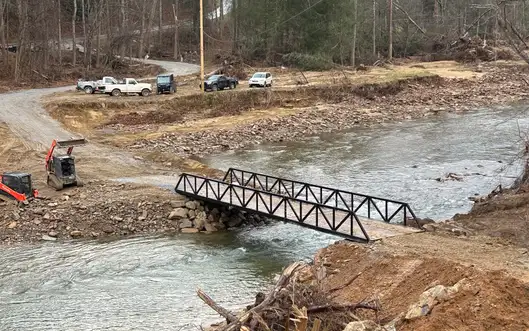
An assembled span arrives on a flatbed, complete, and is lifted into place. The set is often about a day once the abutments are ready. Utility and Pedestrian bridges are built this way, and every span above 20 ft is made up of standard sections bolted together at a plate: a 72 ft Utility is two 20 ft sections and two 16 ft sections. That is why spans over 48 ft ship on two trucks and are bolted together on site before a crane sets them.
A bolt-together kit arrives flat and banded, and is assembled where it is going. It exists for one reason: some crossings cannot be reached by a crane, and a bridge that cannot be lifted into place has to be built in place.
What actually decides it
Span. Kits are 20 ft. If the crossing is longer than that, the question does not arise.
Rating. A kit carries 4 ton in the cataloged 20 ft configuration; a Utility span carries 16,000 lb across 20 to 72 ft. If a delivery truck, a loaded tractor, or a fire engine has to cross, that is a Utility bridge and the format follows from the rating.
Access. Whether a crane or an excavator sized for the span can get to the crossing, and whether the delivery truck can get close enough to be unloaded. Where it cannot, a kit is the answer, and its span and rating are the constraint you plan around rather than a starting point to negotiate up from.
What you have on site. An assembled span needs lifting equipment there on the day. A kit needs people, hand tools, and time.
What each one costs you
The trade is time against equipment.
An assembled span is faster and needs machinery. Most of the work happened in the shop, the crossing is closed for about a day, and the finish and decking arrive already fitted.
A kit is slower and needs almost no machinery. It takes longer to assemble than a span takes to set, because there is more to put together, and that is the whole point: the work moved from a crane to a crew.
Where people get it wrong
The common mistake is buying a kit for a crossing that will eventually take a vehicle heavier than 4 ton, because the site is awkward and a kit is the only thing that fits through the gate.
Access is a solvable problem and a rating is not. Where those two pull in opposite directions, it is worth pricing the harder delivery before accepting the lighter bridge.
The other one is assuming a bridge arrives ready to use. Unloading is the buyer’s or the contractor’s responsibility in both formats, and an assembled span needs equipment sized for it waiting when the truck arrives.
Related questions
What equipment do I need to unload a bridge?
Fully assembled utility spans are set with a single crane pick, so you need a crane or excavator sized for the span and a clear approach. Bolt-together kits ship flat and are handled without a crane. We confirm the requirement for your specific model before delivery.
Can you ship a bridge to my property?
Yes. Bridges ship by freight to the delivery address, including rural and private property. Fully assembled spans arrive on a truck ready to set. Kits ship flat. What matters is whether the truck can physically reach the site and what equipment is waiting when it does.
How long does bridge installation take?
A set is often completed in about a day once the site is prepared and access is in place. The catalog puts installation at two to three weeks including pre-construction coordination, delivery, setting sections on abutments, and a final walkdown with you. Site prep is the variable.
How much weight can a steel bridge hold?
It depends on the family and the configuration. Utility Truss models are rated 8 ton, or 16,000 pounds. Bolt-together kits are rated 4 ton. Pedestrian models are rated 90 PSF as a distributed load. Final capacity for your site comes from the engineered configuration, not a catalog number.
Related bridge systems
Ready to put numbers on it?
The configurator asks seven questions about the span and the load and tells you which families fit and which do not. An engineer reads what it produces.