Application
Commercial and industrial bridges
Site developers, general contractors, facility managers, and industrial property owners.
- Published spans
- 20 to 72 ft
- Widths
- 6, 8 and 10 ft
- Rated
- 16,000 lb
The starting point for a commercial or industrial site
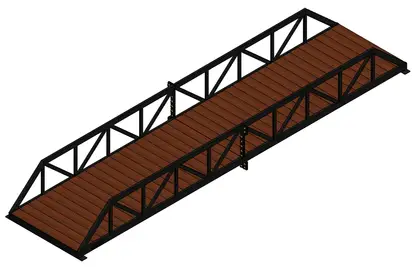
Also worth a look: Bridge Kits.
Commercial and industrial sites: no cataloged family covers that loading. Those crossings are engineered against the actual loading rather than selected from a size table, which is an engineering conversation and worth starting early.
Start with the ceiling
Every published Roadrunner family is rated 8 ton or lighter. The Utility Truss carries 16,000 lb in its cataloged configuration, across spans of 20 to 72 ft at 6, 8 and 10 ft wide. That is the top of the catalog.
For a great deal of commercial work that is the right number. Service roads, site access during construction, crossings for a maintenance truck or a skid steer, drainage crossings on a business park: all of it sits comfortably inside 8 ton.
For industrial loading it is not. A loaded tractor-trailer, a heavy haul, or a crossing that has to be rated for fire apparatus is above the published range, and no cataloged model should be presented as covering it. Those crossings get engineered against the actual loading. That is a conversation with an engineer rather than a selection from a size table, and it is worth having early because the answer changes the foundations as much as the span.
What separates the two
The useful question is not whether a site is commercial. It is what crosses, how heavy it is loaded, and how often.
A distribution yard where a semi crosses daily and a business park where a landscaping trailer crosses weekly are the same kind of property and completely different bridges. Frequency matters as much as peak weight, because a crossing taking its rated load twice a day for twenty years is a fatigue question rather than a capacity question.
Delivery onto a live site
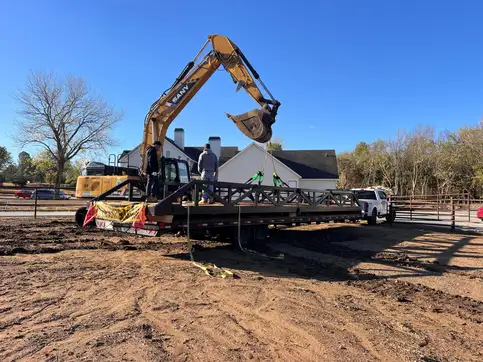
An assembled span arrives on a flatbed. Taking it off is the contractor’s responsibility, and it needs equipment sized for the span on site when the truck arrives. Spans over 48 ft come on two trucks and are bolted together on site before a crane sets them.
On an operating site the constraint is usually not the bridge. It is finding a window where the crane can be positioned and the traffic it blocks can go somewhere else.
Crossings like these
Finished crossings in this kind of setting. Each shows one bridge in one configuration, and none of them is a rating or a promise about yours.
-

A span in the air on a crane pick. -
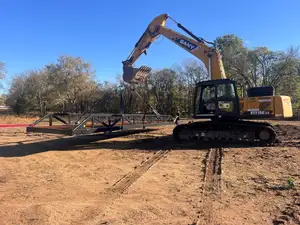
Carried on slings to the abutments. -

An 8 by 40, on blocks outside the shop. -
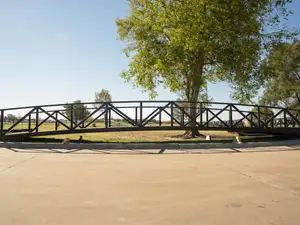
An arched truss span, finished, on blocks outside.
Worth settling before you order
- The published families top out at 8 ton, or 16,000 lb. A loaded semi, a heavy haul, or a fire lane rated for one is above that, and above it the crossing is engineered rather than selected from a table.
- Site access crossings and load-bearing plant crossings are different projects that get described with the same words. What actually drives across, at what weight, on what frequency, is the question that separates them.
- A commercial schedule usually has the bridge on the critical path for something else. About twelve weeks from evaluation to installed is realistic, and the parts that move are site evaluation and design.
- Unloading is the contractor's responsibility and it needs planning. An assembled span arrives on a flatbed and needs equipment on site to take it off, and spans over 48 ft arrive on two trucks to be bolted together before the set.
- Where a crossing is temporary, that is worth saying at the start. It changes the foundation conversation and sometimes the family.
Questions that come up
How much weight can a steel bridge hold?
It depends on the family and the configuration. Utility Truss models are rated 8 ton, or 16,000 pounds. Bolt-together kits are rated 4 ton. Pedestrian models are rated 90 PSF as a distributed load. Final capacity for your site comes from the engineered configuration, not a catalog number.
What equipment do I need to unload a bridge?
Fully assembled utility spans are set with a single crane pick, so you need a crane or excavator sized for the span and a clear approach. Bolt-together kits ship flat and are handled without a crane. We confirm the requirement for your specific model before delivery.
How long does bridge installation take?
A set is often completed in about a day once the site is prepared and access is in place. The catalog puts installation at two to three weeks including pre-construction coordination, delivery, setting sections on abutments, and a final walkdown with you. Site prep is the variable.
Can you provide stamped engineering drawings?
Yes. Designs are stamped and sealed for the project jurisdiction, ready for plan review and permit. Pedestrian models are engineered to the AASHTO LRFD Guide Specifications for the Design of Pedestrian Bridges. Tell us the jurisdiction early, because it shapes the design rather than getting added at the end.
Guides for this crossing
-
 Engineering
What bridge load ratings mean
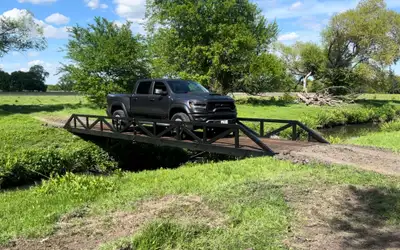
Roadrunner publishes two kinds of rating and they are not comparable. This is what each one describes, what the configurator sizes your answer against, and why a photograph of a machine on a bridge is not permission.
3 min read
-
 Installation
Assembled bridge or bridge kit
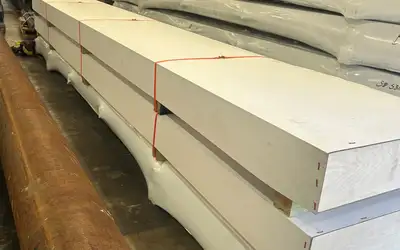
This is not really a preference. Site access and span decide it, and on most crossings only one of the two is available.
2 min read
-
 Freight and delivery
How bridge freight is calculated
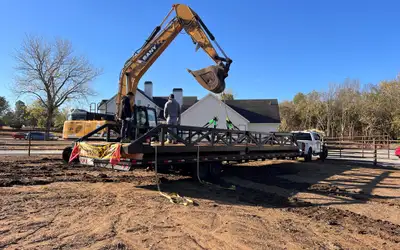
A bridge is oversize, heavy, and going somewhere a truck was not designed to reach. This is what the freight number is built from, and which of those items is usually the one that surprises people.
2 min read
Start with your crossing
Seven questions about the span and what has to get over it, and you get the families that fit and the ones that do not. Or send it to us and an engineer will read it.