Bolt-Together Kits
Bridge Kits
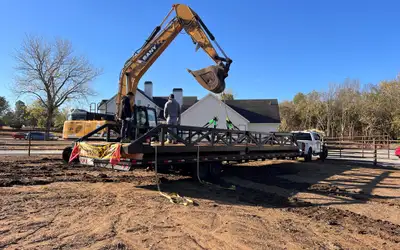
Ships flat. Bolts together on site. No crane.
Ten 4-ton models at 20 and 30 foot spans, in 8 and 10 foot widths, with a 10 inch bump rail or a 36 inch safety handrail. Decked or frame-only. Built for crossings where a crane is not practical.
Or call 903-224-9262 and describe the crossing.
- Span
- 20 to 30 ft
- Width
- 8 and 10 ft
- Rating
- 8,000 lb
- Models
- 10
- From
- $5,950
5 of 10 models priced. Base bridge only, excluding freight and taxes. Not a quote. Freight is quoted per delivery and depends on the route and what can reach the site. Get a price for your configuration
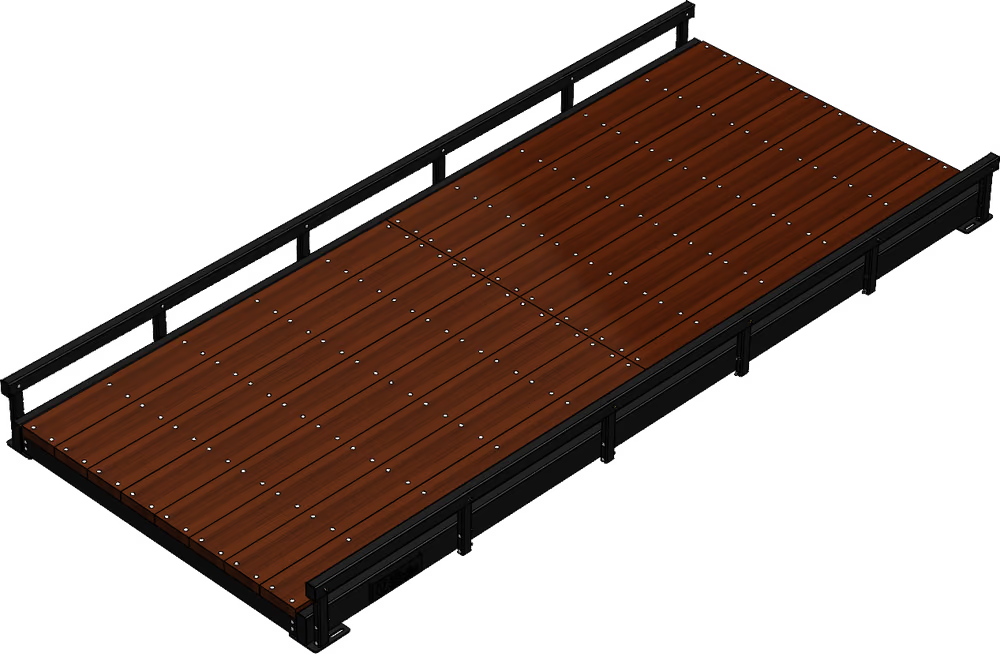
- Model shown
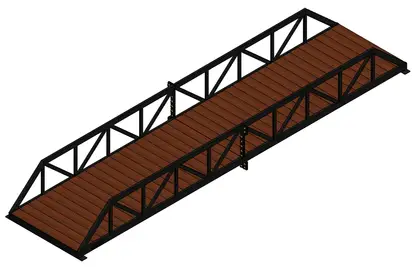
- Kit Bridge, 8 ft x 20 ft, 10 in truss
- Span
- 20 ft
- Deck width
- 8 ft
- Truss depth
- 10 in
- Finish shown
- Powder coat black
Still image of the kit bridge, 8 ft x 20 ft, 10 in truss.
-
1 Bolted splice
The kit ships flat and bolts together on site. This is the joint that makes a crane unnecessary and the reason the family exists.
-
2 Timber deck
Treated timber on steel stringers. Frame-only models leave this off for buyers supplying their own decking.
-
3 Bump rail
The 10 inch bump rail shown here. A 36 inch safety handrail is the other option, and it is what the still image above shows.
A bolt-together bridge for sites a crane cannot reach
Ten bolt-together models. Eight at a 20 foot span in 8 and 10 foot widths, and two more at 8 feet by 30 feet. The kit exists for one reason: some crossings cannot get a crane to them, and a fully assembled span has to be craned into place.
At 20 feet, each width is offered with a 10 inch bump rail or a 36 inch safety handrail, and each of those in a decked or frame-only version. The 8 by 30 comes with a 24 inch rail, decked or frame-only. Frame-only is for buyers supplying their own decking.
The eight 20 foot models are in the 2026 catalog. The 8 by 30 is new and is not in the book yet.
Bridge kits for creek crossings
Most kits go over a creek at the back of a property, where the track in is too soft, too narrow or too steep for a crane truck. The kit is a prefab metal bridge that arrives as parts and is bolted together over the water: the 20 ft span in either width, or the 30 ft span at 8 feet wide. It suits an ATV, a UTV, a golf cart or a mower. At 4 ton in the cataloged configuration it carries half what the Utility Truss does, so size it against the heaviest thing that will ever cross.
The 4 ton, and what frame-only changes
4 ton across the family, in the cataloged configuration. On a frame-only model the deck is yours, so the surface you build affects what the finished crossing can actually do. Talk to engineering before deviating from the standard deck.
Why it ships flat
Flat, on a truck. It assembles on site with hand tools and a few people.
Where a bridge kit fits
The crossings this family is built for. Anything heavier, longer, or less ordinary than these is an engineering conversation rather than a catalog choice.
- Golf carts and UTVs also consider
- Lawn and grounds equipment also consider
- Utility and service access also consider
- Residential drives also consider
Key specifications
| Span | 20 to 30 ft |
|---|---|
| Widths | 8 and 10 ft |
| Load rating | 8,000 lbAll 10 Kit models, 8 ft and 10 ft widths, 20 and 30 ft spans, decked and frame-only |
| Truss depth | Not specified |
| Models | 10 |
| Standard finish | Powder coat black |
| Standard deck | 3" x 12" treated timber |
| Design life | 65 years |
| Origin | Made in USA |
| Engineering review | Before orderEvery crossing is reviewed for its site before it is quoted. |
What it carries
-
8,000 lb
Engineered
- Configuration this applies to
- All 10 Kit models, 8 ft and 10 ft widths, 20 and 30 ft spans, decked and frame-only
Published as 4 ton across the family in the 2026 catalog, at both spans, with a limit of 2 tons per axle. Final capacity depends on the engineered configuration, and on the deck you supply where a frame-only model is chosen.
A rating is not an engineering approval
- Published ratings apply to the cataloged configuration, in the deck and rail it was engineered with.
- What your crossing will carry depends on the engineered configuration for your site, which is settled during design.
- Nothing on this page, and nothing the configurator produces, is an engineering approval for a specific site.
Available sizes
Every model in the family. A crossing that falls between two of them, or outside the range entirely, is a quote rather than a catalog number.
Renders are drawn per model and are not to a common scale. The table carries the dimensions.
| Model | Width | Span | Rail | Deck | Rating |
|---|---|---|---|---|---|
| 8 ft | 20 ft | 10 in | Decked | 4 Ton | |
| 8 ft | 20 ft | 10 in | Frame only | 4 Ton | |
| 8 ft | 20 ft | 36 in | Decked | 4 Ton | |
| 8 ft | 20 ft | 36 in | Frame only | 4 Ton | |
| K-0830-24 | 8 ft | 30 ft | 24 in | Decked | 4 Ton |
| K-0830-24F | 8 ft | 30 ft | 24 in | Frame only | 4 Ton |
| 10 ft | 20 ft | 10 in | Decked | 4 Ton | |
| 10 ft | 20 ft | 10 in | Frame only | 4 Ton | |
| 10 ft | 20 ft | 36 in | Decked | 4 Ton | |
| 10 ft | 20 ft | 36 in | Frame only | 4 Ton |
2026 catalog, page 7
K-0830-24 and K-0830-24F are orderable and not in the 2026 catalog yet. Everything else in the table is off page 7.

Finish, deck, and rail
What the catalog documents for this family. The configurator offers combinations beyond these, and anything not listed here is settled in a quote rather than picked from a table.
Finish
-
Powder coat black
-
Powder coat, custom color
Decking
-
Timber deck
3" x 12" treated timber
-
Frame only, deck supplied by you
Railings
-
Standard steel railing
36 in
-
Bump rail
10 in
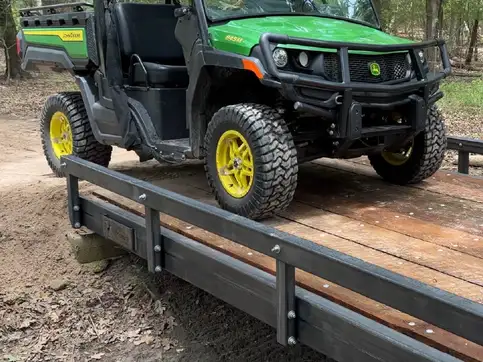
Also in raw steel
The Cowboy
The 20 ft Bridge Kit, 8 and 10 ft wide, ordered without the powder coat. Powder coat is the standard finish.
Raw steel: what you are choosing
- Raw steel will oxidize.
- The appearance will change over time, and it will keep changing.
- How fast it corrodes, and how far, depends on your environment: humidity, rainfall, salt, and how much of the structure stays wet.
- Maintenance may be required to keep the steel where you want it.
- A raw finish is not equivalent to powder-coat protection. Oxidation on these bridges is a surface condition and we will not describe it as a coating.
- It may not suit every climate or every application.
How it arrives
- Flat-packed kit
- Freight delivery
- Collected from us
Freight depends on the crate, the route, and what is waiting at your end to take the bridge off the truck. Crate dimensions and freight classes are not published per model yet, so nothing here quotes a figure.
How shipping works
Freight is quoted separately before your order is finalized, because it depends on where you are, what the access is like, and current rates.
- 1 Request your freight quote
Send us your delivery ZIP code and project details. We will calculate the freight cost and include it with your complete bridge quote.
- 2 Approve your order
Once you review and approve the bridge and freight pricing, we will confirm your order and provide an estimated production and shipping timeline.
- 3 Schedule delivery
When your bridge is ready to ship, our team or the freight carrier will contact you to coordinate the delivery date. Someone must be available at the delivery location to receive and unload the shipment.
- 4 Unload your bridge kit
The bridge arrives on a commercial freight truck. Customers are responsible for providing suitable equipment to unload it, such as a forklift, telehandler, skid steer with forks, or other properly rated equipment.
What you need on delivery day
Make sure the delivery location is accessible to a full-size freight truck and that your unloading equipment is onsite and ready.
- Clear truck access
The delivery location must be accessible to a full-size commercial freight truck. Check for narrow entrances, low branches, soft ground, tight turns, gates, and overhead obstructions.
- Proper unloading equipment
Have a forklift, telehandler, skid steer with forks, or other properly rated equipment ready to unload the shipment. The freight driver is not responsible for unloading the bridge kit.
- An onsite contact
Someone must be present to receive the shipment, inspect it, and sign the delivery paperwork.
- A clear staging area
Choose a level, open area where the bridge kit can be safely unloaded and stored until installation.
- Your delivery paperwork
Review the shipment before signing. Note any visible damage on the delivery receipt and take photos before the driver leaves.
What can add to the freight cost
Limited-access locations, residential delivery, liftgate service, redelivery, or unusual site conditions may result in additional freight charges.
Installation and foundations
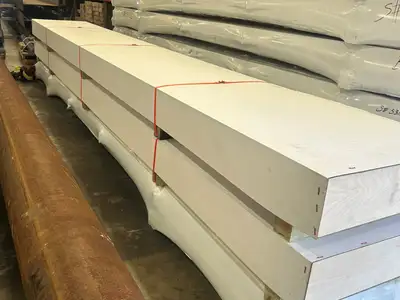
Kits are designed for crossings where heavy equipment access is the constraint. Concrete foundations are recommended for many applications and may not always be required. Bearing conditions at each end still have to carry the load, so the abutment approach is settled during the site evaluation.
Engineering documents
Stamped drawings are prepared for the project jurisdiction on request. Tell us the crossing, the loading, and who is reviewing it.
Fabrication is done in-house and with partner shops.
Watch it happen
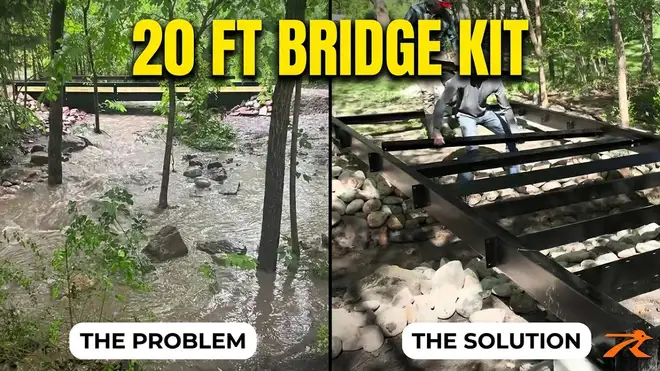
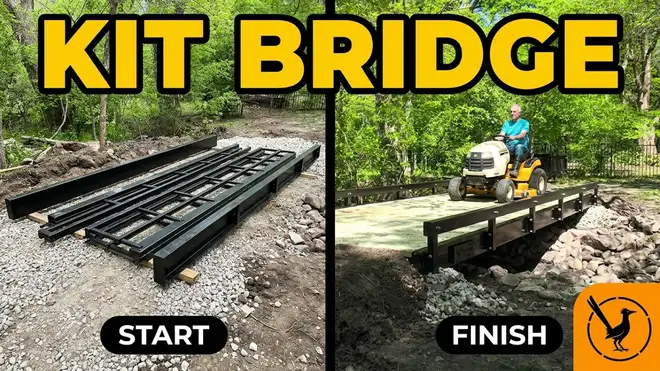
Questions we get about this family
Can I buy a bridge online?
Not yet. Standard kits will move to online checkout once freight and engineering acknowledgements are in place. Today every order goes through a person, which for a structural product on an unseen site is the right sequence. You can configure your bridge online and we respond with a quote.
What equipment do I need to unload a bridge?
Fully assembled utility spans are set with a single crane pick, so you need a crane or excavator sized for the span and a clear approach. Bolt-together kits ship flat and are handled without a crane. We confirm the requirement for your specific model before delivery.
Can I install a bridge without concrete?
Often, yes. Concrete foundations are recommended for many applications and may not always be required. What your crossing needs depends on soil, bank geometry, and the load crossing it. That gets settled during the site evaluation, when someone walks the location with you before anything is fabricated.
Can you ship a bridge to my property?
Yes. Bridges ship by freight to the delivery address, including rural and private property. Fully assembled spans arrive on a truck ready to set. Kits ship flat. What matters is whether the truck can physically reach the site and what equipment is waiting when it does.
How much weight can a steel bridge hold?
It depends on the family and the configuration. Utility Truss models are rated 8 ton, or 16,000 pounds. Bolt-together kits are rated 4 ton. Pedestrian models are rated 90 PSF as a distributed load. Final capacity for your site comes from the engineered configuration, not a catalog number.
Worth reading before you order
-
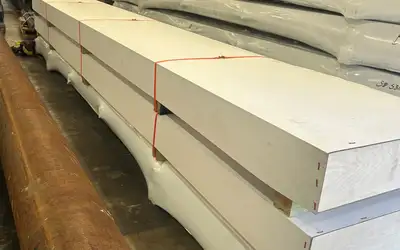 Installation
Assembled bridge or bridge kit
This is not really a preference. Site access and span decide it, and on most crossings only one of the two is available.
2 min read
-
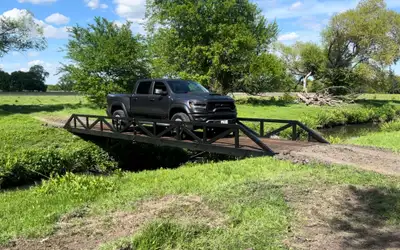 Engineering
What bridge load ratings mean
Roadrunner publishes two kinds of rating and they are not comparable. This is what each one describes, what the configurator sizes your answer against, and why a photograph of a machine on a bridge is not permission.
3 min read
-
 Freight and delivery
How bridge freight is calculated
A bridge is oversize, heavy, and going somewhere a truck was not designed to reach. This is what the freight number is built from, and which of those items is usually the one that surprises people.
2 min read
In the field
This family, finished and in service
Photographs the record ties to this family. Each one shows one bridge in one configuration, and none of them is a rating.
-

A kit over a golf course creek. -
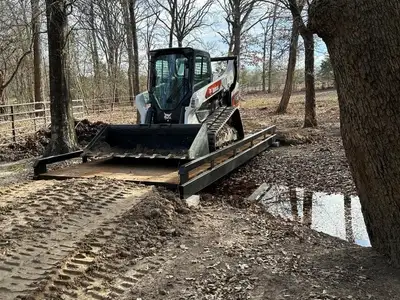
A skid steer crossing. -
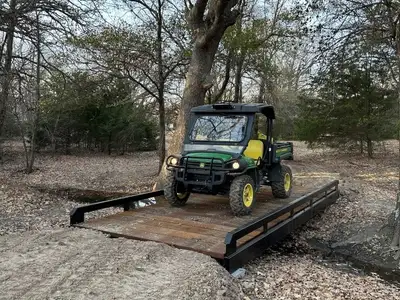
A UTV crossing. -
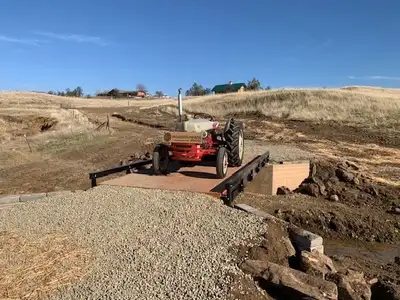
A tractor crossing. -
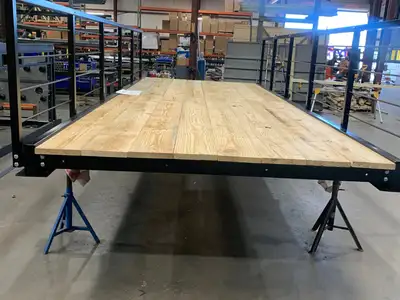
Bolted up, coated and decked before it ships. -
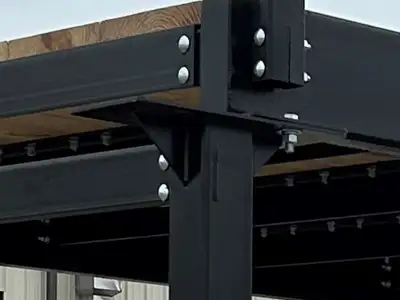
One bolted joint. This is what assembles on site.
Compare
If this is not the one
Every figure below comes from that family's own entry. Ratings apply to the cataloged configuration, and what your crossing will carry is settled during design.
-
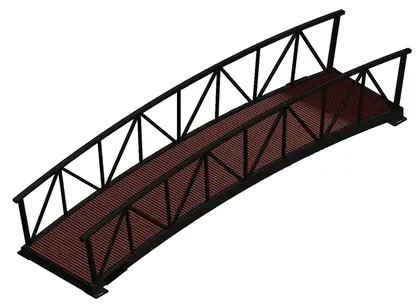
Trail Bridges
60 PSFNarrow, light, and disappears into the landscape.
- Span
- 16 to 36 ft
- Width
- 4 and 8 ft
-
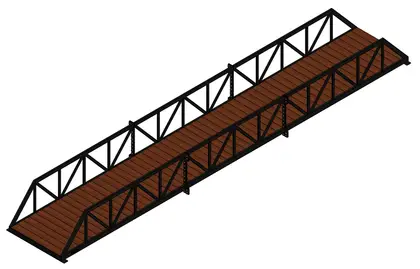
Pedestrian Bridges
90 PSFLong-span crossings for parks, greenways, resorts, and campuses.
- Span
- 40 to 72 ft
- Width
- 8 and 10 ft
-
Utility Bridges
16,000 lb8-ton vehicular spans, delivered assembled and set on prepared abutments.
- Span
- 20 to 72 ft
- Width
- 6, 8 and 10 ft
Start with the crossing.
Tell us the gap, the bank, and what has to drive over it. Everything else follows from those three.