Application
Utility and service access bridges
Utilities, pipeline and right-of-way crews, golf courses, campuses, and anyone maintaining ground on the far side of a ditch.
- Published spans
- 20 to 72 ft
- Widths
- 6, 8 and 10 ft
- Rated
- 16,000 lb
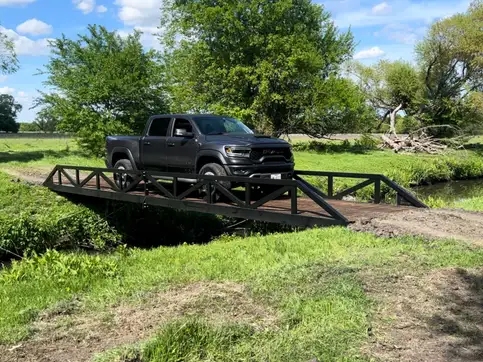
The bridge service roads usually need
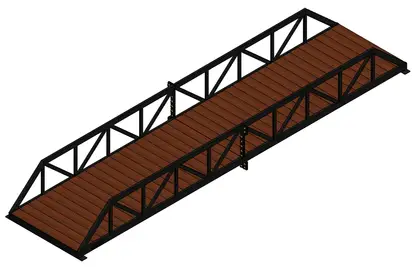
Also worth a look: Bridge Kits.
Access is the whole point
A service crossing is not the destination. It exists so a crew can reach a pump house, a fairway, a substation, or a stretch of right of way, and its job is to be there and be dull. The failure mode that matters is not dramatic collapse. It is a crossing that a truck cannot use, so the crew drives the long way, and the long way becomes the route.
The Utility Truss family spans 20 to 72 ft at 6, 8 and 10 ft wide and is rated 8 ton, or 16,000 lb, on every model. That covers a service truck, a utility tractor, a mid-size skid steer, and a grounds crew with a trailer.
Sizing for the vehicle that shows up later
The specific risk on service access is that the vehicle changes without anyone revisiting the bridge. A crossing installed for a mower and a gator gets used by a contractor’s loader during a renovation, or by a bucket truck after a storm.
Ten feet of width and the full 8 ton rating is not overbuilding on a crossing that will be there for decades. It is the difference between a bridge that stays useful and one that quietly becomes a detour.
Where a kit still makes sense
If the crossing genuinely only ever takes grounds equipment, the span is 20 ft, and there is no realistic way to get a crane to it, the bolt-together Kit is the right tool. It ships flat, assembles in place, and carries 4 ton in the cataloged 20 ft configuration.
That rating is the constraint to plan around rather than a starting point to negotiate up from. A Kit is a Kit.
Getting it in
Utility spans arrive assembled and are set from the bank, often in about a day once the abutments are ready. Spans over 48 ft come on two trucks and are bolted together on site before the crane picks them.
Site access is the thing to check first, because on a right of way or a course it is usually the binding constraint.
Crossings like these
Finished crossings in this kind of setting. Each shows one bridge in one configuration, and none of them is a rating or a promise about yours.
-
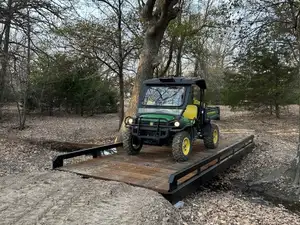
A UTV crossing. -
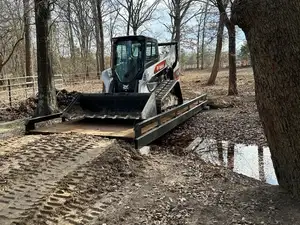
A skid steer crossing. -
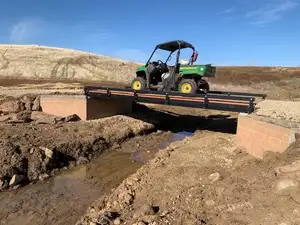
A UTV on a kit, with the excavation still open. -

A course maintenance vehicle, last run of the day.
Worth settling before you order
- A service crossing is sized by the maintenance vehicle, and the maintenance vehicle changes. A crossing built for a mower gets used by whatever the contractor drives up in three years later.
- Access roads are often the reason the crossing exists, which means the bridge has to be reachable by the equipment that installs it. Where a crane cannot get in, that constrains the span before anything else does.
- Seasonal use is still year-round exposure. A crossing used twice a year sits in weather for the other three hundred and sixty days, and the design life is what is being bought.
- On a golf course or a campus the crossing is visible to people who are not using it. Powder coat black is standard, and the finish is doing aesthetic work as well as protective work.
- A 20 ft crossing for grounds equipment alone can be a bolt-together Kit at 4 ton and assembled without a crane. Anything a service truck uses is a Utility span.
Questions that come up
How much weight can a steel bridge hold?
It depends on the family and the configuration. Utility Truss models are rated 8 ton, or 16,000 pounds. Bolt-together kits are rated 4 ton. Pedestrian models are rated 90 PSF as a distributed load. Final capacity for your site comes from the engineered configuration, not a catalog number.
What size bridge do I need?
Measure the crossing bank to bank, then add bearing length at each end. Standard spans run 20 to 72 feet. Width follows what crosses it: 4 feet for foot traffic, 8 feet for a single vehicle, 10 feet for two-way cart traffic or maintenance trucks.
What equipment do I need to unload a bridge?
Fully assembled utility spans are set with a single crane pick, so you need a crane or excavator sized for the span and a clear approach. Bolt-together kits ship flat and are handled without a crane. We confirm the requirement for your specific model before delivery.
How long does bridge installation take?
A set is often completed in about a day once the site is prepared and access is in place. The catalog puts installation at two to three weeks including pre-construction coordination, delivery, setting sections on abutments, and a final walkdown with you. Site prep is the variable.
Guides for this crossing
-
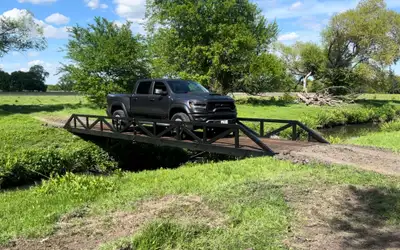 Engineering
What bridge load ratings mean
Roadrunner publishes two kinds of rating and they are not comparable. This is what each one describes, what the configurator sizes your answer against, and why a photograph of a machine on a bridge is not permission.
3 min read
-
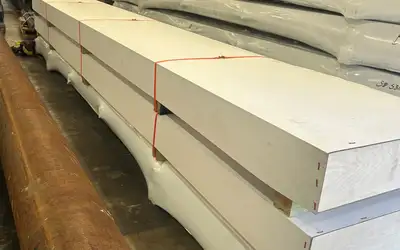 Installation
Assembled bridge or bridge kit
This is not really a preference. Site access and span decide it, and on most crossings only one of the two is available.
2 min read
-
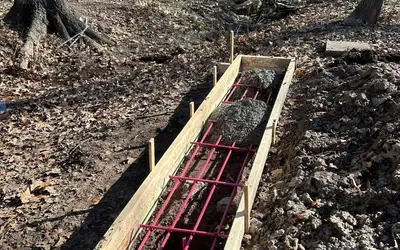 Installation
Abutments, bearing, and when you need concrete
The most common question about a prefabricated bridge is whether it needs concrete. The answer is that it depends on the bank, and this is what the answer depends on.
2 min read
Start with your crossing
Seven questions about the span and what has to get over it, and you get the families that fit and the ones that do not. Or send it to us and an engineer will read it.