How a steel bridge is installed
The bridge is built in a shop and delivered finished, so the work on site is preparation, a lift, and a walkdown. Most of the schedule is the part that happens before the truck arrives.
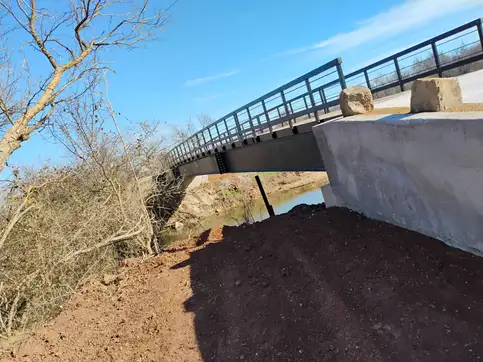
- The set
- Often about a day
- Whole project
- About 12 weeks
- Single pick
- Up to 48 ft
The sequence
Four stages, and these are the four we photograph and can describe accurately.
- 01
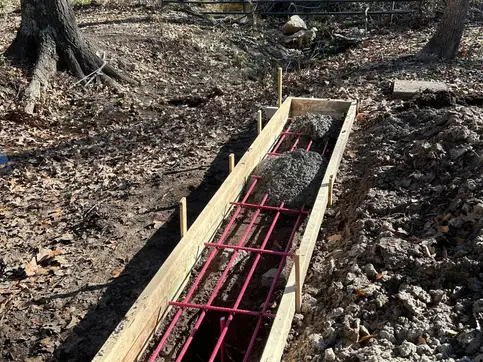
Site preparation
Abutments are formed and poured to the engineered design. This is the part that sets the schedule, and it happens before the bridge arrives.
- 02
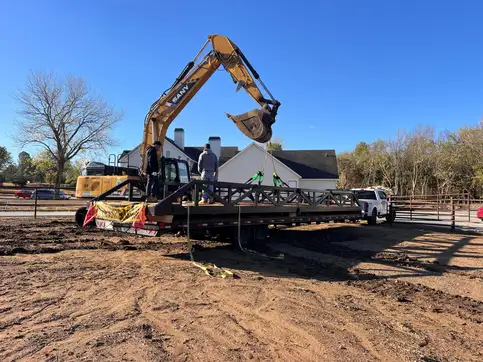
Delivery and rigging
The span arrives assembled on a trailer and is rigged with slings. What matters here is whether the truck can reach the site and what equipment is waiting.
- 03
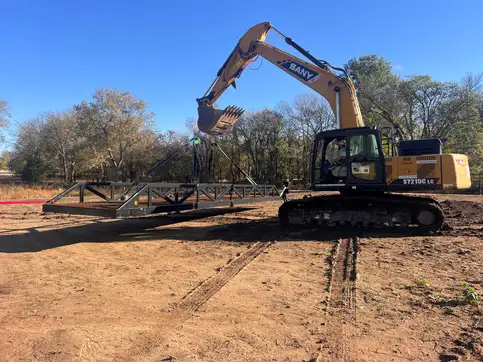
The set
The bridge is lifted clear of the trailer and placed on the prepared abutments. Up to 48 feet that is a single pick with no field fabrication. Longer Utility and Pedestrian spans ship on two trucks and are bolted together on site before the set.
- 04
Ready for use
Decking and rails are finished, the approach is graded, and the crossing is walked down with you before anyone leaves.
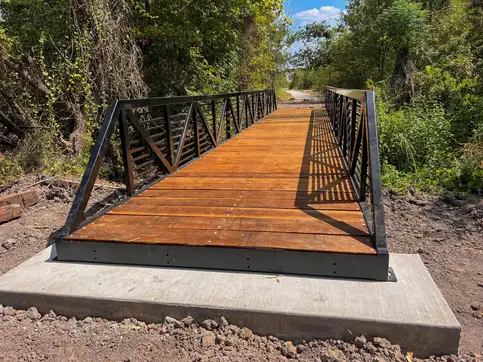
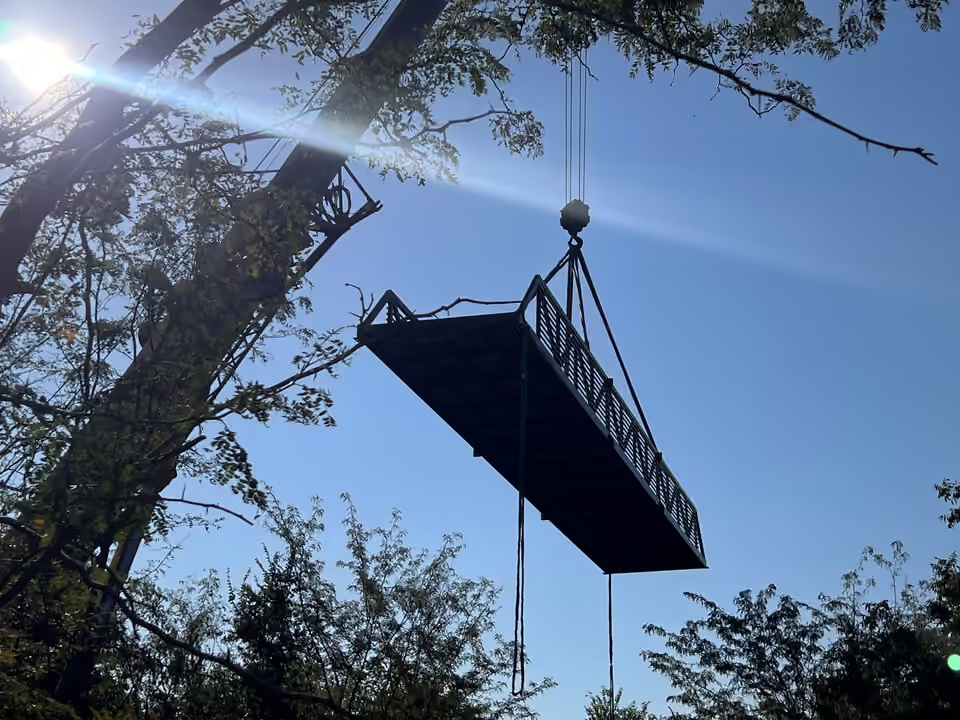
Where the time actually goes
The set is the short part. About twelve weeks is realistic from first conversation to a finished crossing, and the stages that move are the first two.
| Stage | Typical duration | What happens |
|---|---|---|
| Site evaluation, if needed | 1 week | Someone walks the location with you. Not every crossing needs it: many are settled from dimensions and photographs of both banks. |
| Bridge design | 1 to 3 weeks | Engineered for local conditions and loading. |
| Fabrication | 5 to 6 weeks | Built in-house or with certified partners. |
| Installation | 2 to 3 weeks | Coordination, delivery, set, and walkdown. |
2026 catalog, page 11
What Roadrunner does
- Engineers the span for the crossing, and stamps and seals drawings for the project jurisdiction on request.
- Fabricates and finishes the bridge, decking and railing fitted, in the USA.
- Coordinates the delivery date with you and the carrier.
- Walks the finished crossing down with you before anyone leaves.
What you provide
- Abutments and foundations, designed and built to suit the site.
- Approach grading and any bank work either side of the crossing.
- Access for the delivery vehicle, and for whatever lifts the span off it.
- Equipment on site to unload, sized for the span, on the day it arrives.
- Permits, and any approval the jurisdiction requires for the crossing.
The one that catches people
Unloading is yours. An assembled span arrives on a flatbed and something on your end has to lift it off, sized for the span, on the day it arrives.
Foundations set the schedule
Concrete foundations are recommended for many applications and may not always be required. What the abutments need is settled once someone has seen the banks, and it is the question most likely to move a date, because it has to be finished and cured before the bridge can be set on it.
Photographs of both banks and the approach on each side are usually enough to start the conversation.
Planning an install date?
Tell us the span, what has to cross it, and when it has to be open. If a date is already committed, say so at the start rather than at the end.