Buying guide
What to settle before you ask for a quote
Six things decide which bridge you end up with. Most of them you can answer standing at the crossing, and answering them first is the difference between a quote in a day and a fortnight of email.
2 min read Updated August 6, 2026
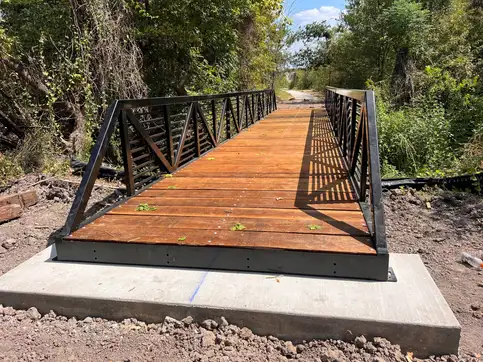
Every quote starts with the same six questions. You can answer five of them yourself, standing at the crossing with a tape measure and a phone, and the sixth is a conversation.
1. The span
Measure bank to bank where the bridge will actually sit, not at the narrowest point of the creek. Then add bearing at each end: the bridge has to land on something stable and that landing is part of the span you order.
If one bank is undercut, or the two sides sit at different heights, photograph both. That single detail changes more designs than any other measurement.
2. The width
Width is where people economize and then regret it, because it is the one dimension that cannot be revisited later.
Four feet carries foot traffic, bikes, and equestrian use. Eight feet carries a single vehicle. Ten feet carries maintenance vehicles or two-way cart traffic. A 4 ft trail bridge cannot be widened to take a mower in five years, so the question is not what crosses now but what will.
3. What crosses it
Not the vehicle you have. The heaviest thing that will ever be driven over it, loaded, on its worst day. A tractor with a full loader and a rear implement, a delivery truck during a build, a fire engine that arrives once.
The published families are rated 8 ton and lighter, so this is also the question that decides whether you are choosing from a catalog or starting an engineering conversation.
4. Site access
Two separate problems, and both are worth walking before anything is ordered.
Can a tractor-trailer reach the crossing? Gates, turning room, low limbs, soft ground after rain. And is there equipment on site, or a way to get it there, to take the span off the truck and set it? Where the answer is no, a bolt-together kit that assembles in place is the route, and that constrains span and rating rather than being a free choice.
5. The banks
Concrete foundations are recommended for many applications and may not always be required. What the abutments need is settled once someone has seen the site, and photographs of both banks are usually enough to start.
6. The date
About twelve weeks from evaluation to installed is realistic: roughly a week of site evaluation, one to three weeks of design, five to six weeks of fabrication, and two to three weeks of installation. The set itself is often about a day once the site is prepared.
If a completion date is already committed, say so at the start rather than at the end. The parts of that timeline that move are evaluation and design, and they move much more easily before fabrication is scheduled.
What happens after you send it
An engineer reads it before anyone talks about price. Nothing on this site is a quote and the configurator is not an engineering approval: what a crossing will carry is settled in the engineered configuration for the site it is going on.
No standard kit is sold online today. Every crossing goes through a person, which is slower and is the reason the answer you get applies to your bank rather than to an average one.
Related questions
What size bridge do I need?
Measure the crossing bank to bank, then add bearing length at each end. Standard spans run 20 to 72 feet. Width follows what crosses it: 4 feet for foot traffic, 8 feet for a single vehicle, 10 feet for two-way cart traffic or maintenance trucks.
How much does a prefabricated steel bridge cost?
Bridge Kits start at $4,950 and Utility Truss spans at $20,750, for the base bridge before freight and taxes. Span, width, load rating, finish, decking and railing all move it. Send your crossing dimensions and we will price the actual configuration rather than a range.
How long does bridge installation take?
A set is often completed in about a day once the site is prepared and access is in place. The catalog puts installation at two to three weeks including pre-construction coordination, delivery, setting sections on abutments, and a final walkdown with you. Site prep is the variable.
Can I buy a bridge online?
Not yet. Standard kits will move to online checkout once freight and engineering acknowledgements are in place. Today every order goes through a person, which for a structural product on an unseen site is the right sequence. You can configure your bridge online and we respond with a quote.
Related bridge systems
-
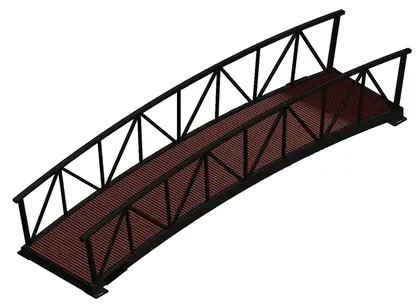
Trail Bridges
60 PSFNarrow, light, and disappears into the landscape.
- Span
- 16 to 36 ft
- Width
- 4 and 8 ft
-
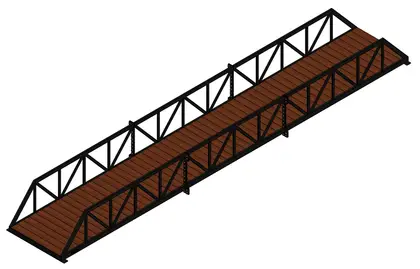
Pedestrian Bridges
90 PSFLong-span crossings for parks, greenways, resorts, and campuses.
- Span
- 40 to 72 ft
- Width
- 8 and 10 ft
-
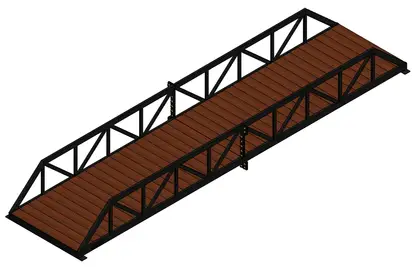
Utility Bridges
16,000 lb8-ton vehicular spans, delivered assembled and set on prepared abutments.
- Span
- 20 to 72 ft
- Width
- 6, 8 and 10 ft
-
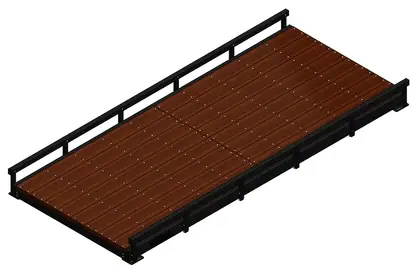
Bridge Kits
8,000 lbShips flat. Bolts together on site. No crane.
- Span
- 20 to 30 ft
- Width
- 8 and 10 ft
Ready to put numbers on it?
The configurator asks seven questions about the span and the load and tells you which families fit and which do not. An engineer reads what it produces.